Strength after 40 · Part 1
Is it safe to start lifting weights after 40?
The short version is yes. The longer version is about how you start, and why the gentle option is often the riskier one.
Yes. Starting to lift weights after 40 is safe for most people when it’s coached, starts at the right level and gets heavier gradually. Even in older adults, a Cochrane review of 121 trials found serious problems were rare and none were directly linked to the training. The bigger risk is losing muscle by not lifting at all.
It’s one of the questions we hear most often from people in their forties who walk into our gym in Randwick, usually followed by a story about a friend who hurt their back. So here’s what the research actually says, and what makes the difference between lifting safely and getting hurt.
What does the research say about lifting weights safely?
It says strength training is one of the most effective and safest things adults can do, and that holds even in people much older than 40. A Cochrane review pooled 121 trials with 6,700 older adults and found progressive strength training produced large gains in strength and made everyday tasks easier. Most of those trials trained two to three times a week at a genuinely challenging intensity.
The most common side effects were sore muscles and achy joints in the first weeks. Serious problems were rare, and none were reported as directly caused by the exercise. The authors did note that many trials recorded side effects poorly, which is one more reason to train with someone keeping an eye on you.
If it’s safe and effective for people in their seventies and eighties, starting at 40 or 50 puts you in a very good position.

Why is not lifting the bigger risk?
Because muscle loss is guaranteed if you do nothing. Inactive adults lose roughly 3 to 8 percent of their muscle each decade from about 30, along with a slower metabolism and more body fat. Less muscle means a back that complains after gardening, knees that ache on the stairs and a harder time staying active for the next 40 years.
The “gentle” option feels safer, but very light weights and easy classes don’t give muscle much reason to adapt. Safe and challenging are not opposites. The goal is challenging enough to change, controlled enough to stay injury free.
What are the real risks, and how do you avoid them?
Most injuries in people starting out after 40 come from three things: doing too much too soon, poor technique under load, and ignoring pain. All three are avoidable with a sensible plan and someone watching.
- Too much, too soon. Start with weights you could lift 10 to 12 times with good form. Add load over weeks, not sessions.
- Training like you did at 25. Your engine may still be there, but tendons and joints need time to catch up. Build volume gradually.
- Technique under load. Learn the squat, hinge, push and pull with light weights first. A coach spots the small things before they become sore backs.
- Pushing through pain. Muscle effort is fine. Sharp or joint pain means change the exercise, the range or the load.
- Skipping recovery. Two or three sessions a week with a rest day between beats five sessions you can’t recover from.

Can you lift with a bad back, arthritis or an old injury?
Usually yes, with the right adjustments. People with osteoarthritis in the Cochrane review reported less pain after strength training, and a review in Current Sports Medicine Reports notes strength work can help reduce low back pain. In the LIFTMOR trial from Griffith University, women with low bone density lifted above 85 percent of their maximum twice a week for eight months, with one minor back spasm reported, and their spine bone density increased.
An old shoulder, a dodgy knee or a recent surgery changes how the program is built, not whether you can train. Get cleared by your GP if you need to, then work with a coach or exercise physiologist who plans around it from day one.
How should you start lifting after 40?
Start with two sessions a week, built around a handful of big movements, with a weight you can control and a coach watching. Australia’s physical activity guidelines recommend muscle strengthening on at least two days a week for all adults.
A good first month looks like this: learn the movements, find your starting weights, and leave each session feeling like you could have done a bit more. From there, the weights go up gradually. Next week we’ll lay out a full sample week, and the bigger picture is in our complete guide to strength training after 40.
What this looks like at Catalyst
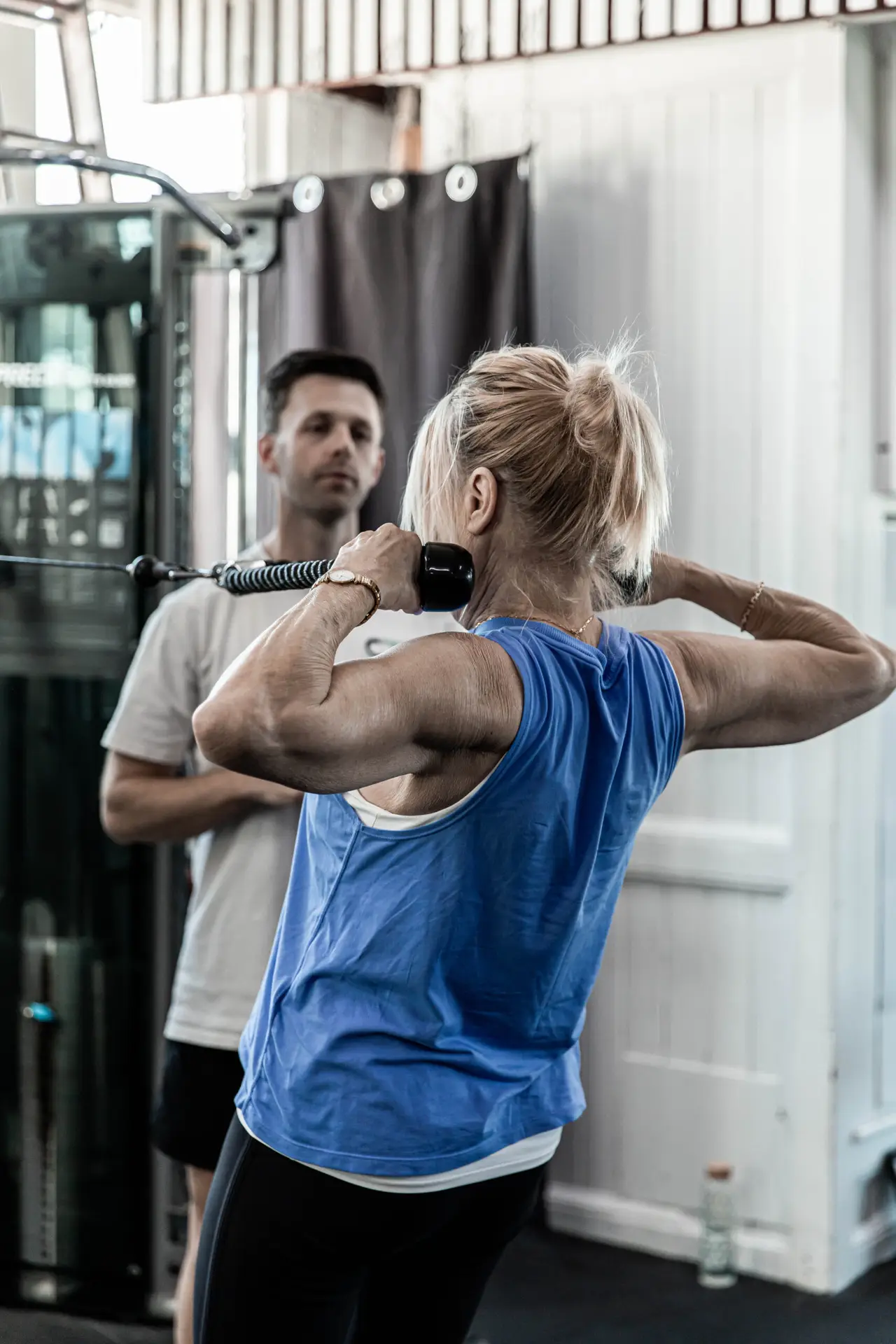
Everyone who starts with us at 115 Avoca Street, Randwick talks through their history first: injuries, conditions, what hurts and what they want to be able to do. From there you can train in coached small group sessions, where numbers are capped so the coach can actually watch your lifts, or one to one through personal training. If you’re managing a condition, our exercise physiologist can help plan around it.
Common questions
Is it safe to lift heavy weights after 40?
For most healthy people, yes, once you have built up to it. Trials regularly use challenging weights even in people well past 60, and in the LIFTMOR trial women with low bone density lifted above 85 percent of their maximum with one minor injury reported. Start lighter, learn the technique, then progress.
Do I need a doctor's clearance to start strength training?
If you have a heart condition, high blood pressure, diabetes, a joint replacement or a recent injury, check with your GP first. If you are generally well, you can start with a coach who screens you before your first session and builds the program around your history.
Can I lift weights with arthritis or a bad back?
Usually, yes. A Cochrane review found people with osteoarthritis reported less pain after progressive strength training, and strength work is commonly used to manage low back pain. Choose comfortable movements and ranges, progress gradually and avoid pushing through sharp pain.
I haven't trained in years. Where do I start?
With two sessions a week, a weight you can lift with good form for 10 to 12 reps, and a coach watching your technique. Add load slowly over weeks, and keep a rest day between sessions.
Is it safe to lift weights with osteoporosis?
Often yes, and it can help. In the LIFTMOR trial, supervised heavy lifting increased spine bone density in postmenopausal women with low bone mass. Get screened, build up gradually and train under qualified supervision.
Start with a coach beside you
Lift safely, from your first session.
Train for seven days at our gym at 115 Avoca Street, Randwick. Coaches are on the floor every session to set your weights, watch your technique and adjust around anything that hurts.
$79 · 7 days of full access · No lock in
- Liu CJ, Latham NK. Progressive resistance strength training for improving physical function in older adults. Cochrane Database of Systematic Reviews, 2009.
- Westcott WL. Resistance training is medicine: effects of strength training on health. Current Sports Medicine Reports, 2012.
- Watson SL et al. The LIFTMOR randomised controlled trial. Journal of Bone and Mineral Research, 2018.
- Volpi E, Nazemi R, Fujita S. Muscle tissue changes with aging. Current Opinion in Clinical Nutrition and Metabolic Care, 2004.
- Australian Government Department of Health, Disability and Ageing. Physical activity recommendations for adults 18 to 64 years.
Enquire now.
Interested in joining, or have a question? Fill in the form and one of our team will be in touch shortly.